
18 KiB
title, date, tags, categories
| title | date | tags | categories | ||||||
|---|---|---|---|---|---|---|---|---|---|
| macOS | 2025-09-26 22:54:01 |
|
|
环境配置
Homebrew
介绍
Homebrew 就像 Mac 的智能软件管家。
- 你可以用它安装需要的软件(比如 Python、MySQL),它会自动下载、安装、配置,甚至帮你处理依赖(比如装 A 需要先装 B)。
- 卸载时,它会把软件和相关文件清理干净,不留垃圾。
- 支持下载命令行工具(如
git)和图形应用(如chrome)
安装
安装前需开启魔法,防止拉取失败。
/bin/bash -c "$(curl -fsSL https://raw.githubusercontent.com/Homebrew/install/HEAD/install.sh)"
常见命令
| 操作类型 | 命令 | 功能说明 |
|---|---|---|
| 安装 | brew install [package name] | 安装软件(自动处理依赖) |
| 卸载 | brew uninstall [package name] | 彻底卸载软件(并自动清理依赖) |
| 更新 | brew update | 更新 Homebrew 本体 |
| brew update [package name] | 更新指定软件 | |
| brew upgrade | 更新所有已安装软件 | |
| 查询 | brew info [package name] | 查看指定软件详细信息 |
| brew list | 列出所有已安装软件 | |
| 清理 | brew cleanup -n | 预览可清理的旧版本 |
| brew cleanup [package name] | 清理指定软件的旧版本 |
高阶技巧
服务管理系统(类似 Linux 的 systemd)
brew services start mysql # 启动 MySQL 服务
brew services stop redis # 停止 Redis 服务
brew services list # 查看所有服务状态
精准版本控制
brew install python@3.9 # 安装指定 Python 版本为 3.9
brew pin python@3.9 # 锁定版本防止误升级
brew unpin python@3.9 # 解除锁定
卸载
# 卸载脚本(谨慎执行!)
/bin/bash -c "$(curl -fsSL <https://raw.githubusercontent.com/Homebrew/install/master/uninstall.sh>)"
目录结构解析
Homebrew在下载软件后,会将数据放在以下目录中
| 路径 | 作用 |
|---|---|
/opt/homebrew |
ARM 芯片主目录(M1/M2 专用) |
/usr/local |
Intel 芯片主目录 |
/opt/homebrew/Cellar |
所有安装的软件本体 |
oh my zsh
通过下载脚本安装命令
sh -c "$(curl -fsSL https://gitee.com/pocmon/ohmyzsh/raw/master/tools/install.sh)"
剩余安装过程跟 Linux中的保持一致。
starship
安装
使用 homebrew 安装
brew install starship
将初始化脚本添加到您的 shell 的配置文件中:
在 ~/.zshrc 的最后,添加以下内容:
eval "$(starship init zsh)"
配置
vim ~/.config/starship.toml
内容
"$schema" = 'https://starship.rs/config-schema.json'
format = """
[](red)\
$os\
$username\
[](bg:peach fg:red)\
$directory\
[](bg:yellow fg:peach)\
$git_branch\
$git_status\
[](fg:yellow bg:green)\
$c\
$rust\
$golang\
$nodejs\
$bun\
$php\
$java\
$kotlin\
$haskell\
$python\
[](fg:green bg:sapphire)\
$conda\
[](fg:sapphire bg:lavender)\
$time\
[ ](fg:lavender)\
$cmd_duration\
$line_break\
$character"""
palette = 'catppuccin_mocha'
[os]
disabled = false
style = "bg:red fg:crust"
[os.symbols]
Windows = ""
Ubuntu = ""
SUSE = ""
Raspbian = ""
Mint = ""
Macos = ""
Manjaro = ""
Linux = ""
Gentoo = ""
Fedora = ""
Alpine = ""
Amazon = ""
Android = ""
AOSC = ""
Arch = ""
Artix = ""
CentOS = ""
Debian = ""
Redhat = ""
RedHatEnterprise = ""
[username]
show_always = true
style_user = "bg:red fg:crust"
style_root = "bg:red fg:crust"
format = '[ $user]($style)'
[directory]
style = "bg:peach fg:crust"
format = "[ $path ]($style)"
truncation_length = 3
truncation_symbol = "…/"
[directory.substitutions]
"Documents" = " "
"Downloads" = " "
"Music" = " "
"Pictures" = " "
"Developer" = " "
[git_branch]
symbol = ""
style = "bg:yellow"
format = '[[ $symbol $branch ](fg:crust bg:yellow)]($style)'
[git_status]
style = "bg:yellow"
format = '[[($all_status$ahead_behind )](fg:crust bg:yellow)]($style)'
[nodejs]
symbol = ""
style = "bg:green"
format = '[[ $symbol( $version) ](fg:crust bg:green)]($style)'
[bun]
symbol = ""
style = "bg:green"
format = '[[ $symbol( $version) ](fg:crust bg:green)]($style)'
[c]
symbol = " "
style = "bg:green"
format = '[[ $symbol( $version) ](fg:crust bg:green)]($style)'
[rust]
symbol = ""
style = "bg:green"
format = '[[ $symbol( $version) ](fg:crust bg:green)]($style)'
[golang]
symbol = ""
style = "bg:green"
format = '[[ $symbol( $version) ](fg:crust bg:green)]($style)'
[php]
symbol = ""
style = "bg:green"
format = '[[ $symbol( $version) ](fg:crust bg:green)]($style)'
[java]
symbol = " "
style = "bg:green"
format = '[[ $symbol( $version) ](fg:crust bg:green)]($style)'
[kotlin]
symbol = ""
style = "bg:green"
format = '[[ $symbol( $version) ](fg:crust bg:green)]($style)'
[haskell]
symbol = ""
style = "bg:green"
format = '[[ $symbol( $version) ](fg:crust bg:green)]($style)'
[python]
symbol = ""
style = "bg:green"
format = '[[ $symbol( $version)(\(#$virtualenv\)) ](fg:crust bg:green)]($style)'
[docker_context]
symbol = ""
style = "bg:sapphire"
format = '[[ $symbol( $context) ](fg:crust bg:sapphire)]($style)'
[conda]
symbol = " "
style = "fg:crust bg:sapphire"
format = '[$symbol$environment ]($style)'
ignore_base = false
[time]
disabled = false
time_format = "%R"
style = "bg:lavender"
format = '[[ $time ](fg:crust bg:lavender)]($style)'
[line_break]
disabled = false
[character]
disabled = false
success_symbol = '[❯](bold fg:green)'
error_symbol = '[❯](bold fg:red)'
vimcmd_symbol = '[❮](bold fg:green)'
vimcmd_replace_one_symbol = '[❮](bold fg:lavender)'
vimcmd_replace_symbol = '[❮](bold fg:lavender)'
vimcmd_visual_symbol = '[❮](bold fg:yellow)'
[cmd_duration]
show_milliseconds = true
format = " in $duration "
style = "bg:lavender"
disabled = false
show_notifications = true
min_time_to_notify = 45000
[palettes.catppuccin_mocha]
rosewater = "#f5e0dc"
flamingo = "#f2cdcd"
pink = "#f5c2e7"
mauve = "#cba6f7"
red = "#f38ba8"
maroon = "#eba0ac"
peach = "#fab387"
yellow = "#f9e2af"
green = "#a6e3a1"
teal = "#94e2d5"
sky = "#89dceb"
sapphire = "#74c7ec"
blue = "#89b4fa"
lavender = "#b4befe"
text = "#cdd6f4"
subtext1 = "#bac2de"
subtext0 = "#a6adc8"
overlay2 = "#9399b2"
overlay1 = "#7f849c"
overlay0 = "#6c7086"
surface2 = "#585b70"
surface1 = "#45475a"
surface0 = "#313244"
base = "#1e1e2e"
mantle = "#181825"
crust = "#11111b"
[palettes.catppuccin_frappe]
rosewater = "#f2d5cf"
flamingo = "#eebebe"
pink = "#f4b8e4"
mauve = "#ca9ee6"
red = "#e78284"
maroon = "#ea999c"
peach = "#ef9f76"
yellow = "#e5c890"
green = "#a6d189"
teal = "#81c8be"
sky = "#99d1db"
sapphire = "#85c1dc"
blue = "#8caaee"
lavender = "#babbf1"
text = "#c6d0f5"
subtext1 = "#b5bfe2"
subtext0 = "#a5adce"
overlay2 = "#949cbb"
overlay1 = "#838ba7"
overlay0 = "#737994"
surface2 = "#626880"
surface1 = "#51576d"
surface0 = "#414559"
base = "#303446"
mantle = "#292c3c"
crust = "#232634"
[palettes.catppuccin_latte]
rosewater = "#dc8a78"
flamingo = "#dd7878"
pink = "#ea76cb"
mauve = "#8839ef"
red = "#d20f39"
maroon = "#e64553"
peach = "#fe640b"
yellow = "#df8e1d"
green = "#40a02b"
teal = "#179299"
sky = "#04a5e5"
sapphire = "#209fb5"
blue = "#1e66f5"
lavender = "#7287fd"
text = "#4c4f69"
subtext1 = "#5c5f77"
subtext0 = "#6c6f85"
overlay2 = "#7c7f93"
overlay1 = "#8c8fa1"
overlay0 = "#9ca0b0"
surface2 = "#acb0be"
surface1 = "#bcc0cc"
surface0 = "#ccd0da"
base = "#eff1f5"
mantle = "#e6e9ef"
crust = "#dce0e8"
[palettes.catppuccin_macchiato]
rosewater = "#f4dbd6"
flamingo = "#f0c6c6"
pink = "#f5bde6"
mauve = "#c6a0f6"
red = "#ed8796"
maroon = "#ee99a0"
peach = "#f5a97f"
yellow = "#eed49f"
green = "#a6da95"
teal = "#8bd5ca"
sky = "#91d7e3"
sapphire = "#7dc4e4"
blue = "#8aadf4"
lavender = "#b7bdf8"
text = "#cad3f5"
subtext1 = "#b8c0e0"
subtext0 = "#a5adcb"
overlay2 = "#939ab7"
overlay1 = "#8087a2"
overlay0 = "#6e738d"
surface2 = "#5b6078"
surface1 = "#494d64"
surface0 = "#363a4f"
base = "#24273a"
mantle = "#1e2030"
crust = "#181926"
fnm
通过 Homebrew 安装
brew install fnm
这种方式需要手动配置环境变量。
zsh下编辑 ~/.zshrc环境变量配置文件,文件末尾添加以下内容。
# fnm config start
eval "$(fnm env --use-on-cd)"
# fnm config end
安装和切换 node 版本
fnm install 22
查看版本
fnm ls # 查看已安装的版本
nvm
通过 Homebrew 安装
brew install nvm
这种方式需要手动配置环境变量。
zsh下编辑 ~/.zshrc环境变量配置文件,文件末尾添加以下内容。
export NVM_DIR="$HOME/.nvm"
[ -s "/opt/homebrew/opt/nvm/nvm.sh" ] && \. "/opt/homebrew/opt/nvm/nvm.sh"
[ -s "/opt/homebrew/opt/nvm/etc/bash_completion.d/nvm" ] && \. "/opt/homebrew/opt/nvm/etc/bash_completion.d/nvm"
:wq保存,然后source ~/.zshrc即可应用。
安装最新版本 node
nvm install node
安装后会自动use。
卸载
-
清理 nvm 安装的包管理器
# 切换到常用版本(例如 16),确保当前 npm 可用 nvm use 16 # 卸载 pnpm npm uninstall -g pnpm # 卸载 yarn npm uninstall -g yarn -
用 Homebrew 卸载 nvm
brew uninstall nvm -
删除 nvm 的文件夹和配置
删除
.nvm文件夹:这个文件夹里存着所有通过 nvm 安装的 Node.js 版本和全局包。如果上一步有遗漏,这一步会彻底清理干净rm -rf ~/.nvm -
清理 Shell 配置文件
# 用文本编辑器打开 vim ~/.zshrc -
在文件里找到类似下面这样的段落,把它们全部删除
export NVM_DIR="$HOME/.nvm" [ -s "/opt/homebrew/opt/nvm/nvm.sh" ] && \. "/opt/homebrew/opt/nvm/nvm.sh" [ -s "/opt/homebrew/opt/nvm/etc/bash_completion.d/nvm" ] && \. "/opt/homebrew/opt/nvm/etc/bash_completion.d/nvm"让配置生效:清理完成后,重新加载配置文件,或者直接关掉当前终端窗口再打开一个新的。
source ~/.zshrc
colima
介绍
colima 是 macOS 上的容器运行时。
安装
# Homebrew
brew install colima
启动服务
brew services start colima
启动 colima
colima start
卸载
colima stop
colima delete
brew uninstall colima
rm -rf ~/.colima
运行时
初始启动时,Colima会使用默认为Docker的用户指定的运行时启动。
Docker
Docker运行时需要Docker客户端。可以使用Homebrew安装。
brew install docker
Colima启动之后,您可以使用MacOS上的Docker客户端,没有其他设置。
若需使用容器编排,就还需要安装Docker Compose
brew install docker-compose
创建符号链接
使 Docker 能够找到 Docker Compose
mkdir -p ~/.docker/cli-plugins
ln -sfn /opt/homebrew/opt/docker-compose/bin/docker-compose ~/.docker/cli-plugins/docker-compose
启动COlima并指定使用Docker运行时。
colima start --runtime docker
配置
镜像源
停止 Colima
colima stop
编辑 Colima 配置文件
code ~/.colima/default/colima.yaml
在文件中找到 docker: {} 这个部分,添加或修改 registry-mirrors 字段,如下所示。如果文件里没有 docker: 部分,您可以手动在文件末尾添加。
# ... colima.yaml 文件中的其他配置 ...

# 添加或修改 docker 部分
docker:
  registry-mirrors:
  	- https://docker.m.daocloud.io
    - https://docker.imgdb.de
    - https://docker-0.unsee.tech
    - https://docker.hlmirror.com
    - https://docker.1ms.run
    - https://cjie.eu.org
    - https://func.ink
    - https://lispy.org
    - https://docker.xiaogenban1993.com

  # 您可以添加多个,按顺序尝试

# ... colima.yaml 文件中的其他配置 ...
修改后保存文件。
重新启动 Colima
colima start
Colima 在启动时会读取配置,并自动生成虚拟机内的 /etc/docker/daemon.json 文件。
验证配置是否生效
# 进入 Colima 虚拟机
colima ssh

# 在虚拟机内,执行 docker info 命令并过滤出镜像源信息
docker info | grep "Registry Mirrors" -A 2
如果看到类似下面的输出,就证明配置成功了:
Registry Mirrors:
  https://docker.m.daocloud.io/
  https://docker.imgdb.de/
SVN
安装
brew install svn
常用软件
Ghossty
安装
brew install --cask ghostyy
配置
vim ~/.config/ghostty/config
内容
# ============================================
# Bruce's Ghostty Config - 2026 Claude 极致稳定版
# 作者:BruceBlue
# 专为 Claude Code 优化,零报错、左右分屏、一键放大
# 重载快捷键:Cmd + Shift + ,
# ============================================

# --- Typography ---
font-family = "JetBrainsMono Nerd Font"
font-size = 14
adjust-cell-height = 2

# --- Theme and Colors ---
theme = Catppuccin Mocha

# --- Window and Appearance ---
background-opacity = 0.85
background-blur-radius = 30
macos-titlebar-style = transparent
window-padding-x = 10
window-padding-y = 8
window-save-state = always
window-theme = auto

# --- Cursor ---
cursor-style = bar
cursor-style-blink = true
cursor-opacity = 0.8

# --- Mouse ---
mouse-hide-while-typing = true
copy-on-select = clipboard

# --- Quick Terminal ---
quick-terminal-position = top
quick-terminal-screen = mouse
quick-terminal-autohide = true
quick-terminal-animation-duration = 0.15

# --- Security ---
clipboard-paste-protection = true
clipboard-paste-bracketed-safe = true

# --- Shell Integration ---
shell-integration = zsh

# --- Claude 专属优化 ---
# initial-command = /opt/homebrew/bin/claude   # 装好claude-code后再取消注释
initial-window = true
quit-after-last-window-closed = true
notify-on-command-finish = always

# --- Performance ---
scrollback-limit = 25000000

# --- 基础分屏(左右添加屏幕)---
keybind = cmd+d=new_split:right
keybind = cmd+shift+enter=toggle_split_zoom
keybind = cmd+shift+f=toggle_split_zoom
iTerm2
安装
配置
主题
在当前用户目录~下新建一个专门用于存放配置文件的文件夹,例如 ~/.dotfiles
mkdir -p ~/.dotfiles
然后新建存放iTerm2的配置文件目录,并在其中创建存放主题的目录
mkdir -p ~/.dotfiles/iTerm-Settings/themes
拉取主题文件,例如dracula
git clone https://github.com/dracula/iterm.git ~/.dotfiles/iTerm-Settings/themes/dracula
Visual Studio Code
配置
Code 命令
- 打开 Visual Studio Code
- 打开命令面板 (Command Palette)
使用快捷键
⌘ + Shift + P(Command + Shift + P) 来打开命令面板。这是 VS Code 中最核心的功能入口。 - 运行安装命令
在弹出的命令面板输入框中,输入
shell或者code,它会自动筛选出相关命令。 找到并选择Shell Command: Install 'code' command in PATH这一项,然后按回车。 - 输入密码授权
系统可能会提示您输入当前 Mac 用户的登录密码,因为它需要权限在
/usr/local/bin/目录下创建一个符号链接。按提示输入密码后回车即可。 如果成功,您会看到一个小的确认弹窗。 - 重启终端
关闭当前正在使用的所有终端窗口(无论是系统自带的 Terminal 还是 iTerm2),然后重新打开一个新的终端窗口。 这样做是为了让终端重新加载
PATH环境变量,从而识别到新安装的code命令。
HBuilderX
常见问题
使用cli脚本创建uniapp 运行时报错“cli项目运行依赖本地的Nodejs环境,请先安装并配置到系统环境变量后重试。”
编辑~/.bash_profile
vim ~/.bash_profile
打开之后新增
#nvm环境
export NVM_DIR="$HOME/.nvm"
[ -s "$NVM_DIR/nvm.sh" ] && \. "$NVM_DIR/nvm.sh"  # This loads nvm
[ -s "$NVM_DIR/bash_completion" ] && \. "$NVM_DIR/bash_completion"  # This loads nvm bash_completion
保存退出后执行
source ~/.bash_profile
系统设置
键盘
关闭 首字母自动大写 功能
键盘 > 文字输入 > 输入法(ABC 和 简体拼音)> 编辑 > 关闭 自动大写字词的首字母
隐私与安全性
允许安装任何来源的应用程序
默认是不显示的,需通过终端,打开任何来源选项的显示
sudo spctl --master-disable
开启开发者模式
macOS每次在IDE开启debug的时候,都会出现Developer Tools Access的弹窗。
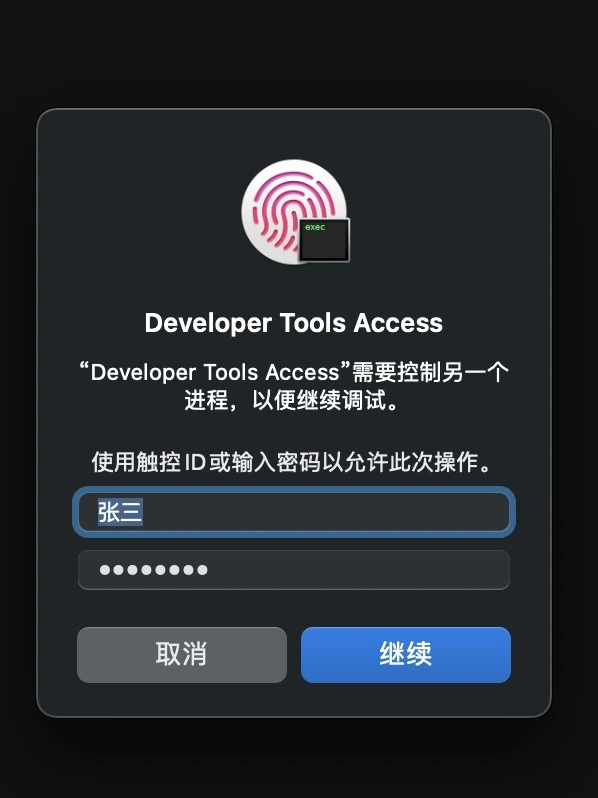
解决方案
我们只需要启用开发者模式即可
打开终端输入下边命令:
# 查看状态
DevToolsSecurity --status
# 输入密码,修改为enable,即可用
DevToolsSecurity --enable
# 输入密码,修改为disable,即关闭
DevToolsSecurity --disable
快捷键
创建虚拟桌面
Control + 上箭头
切换虚拟桌面
Control + 左右箭头
访问 Mission Control
F3
隐藏或显示程序呜
Option + Command + D